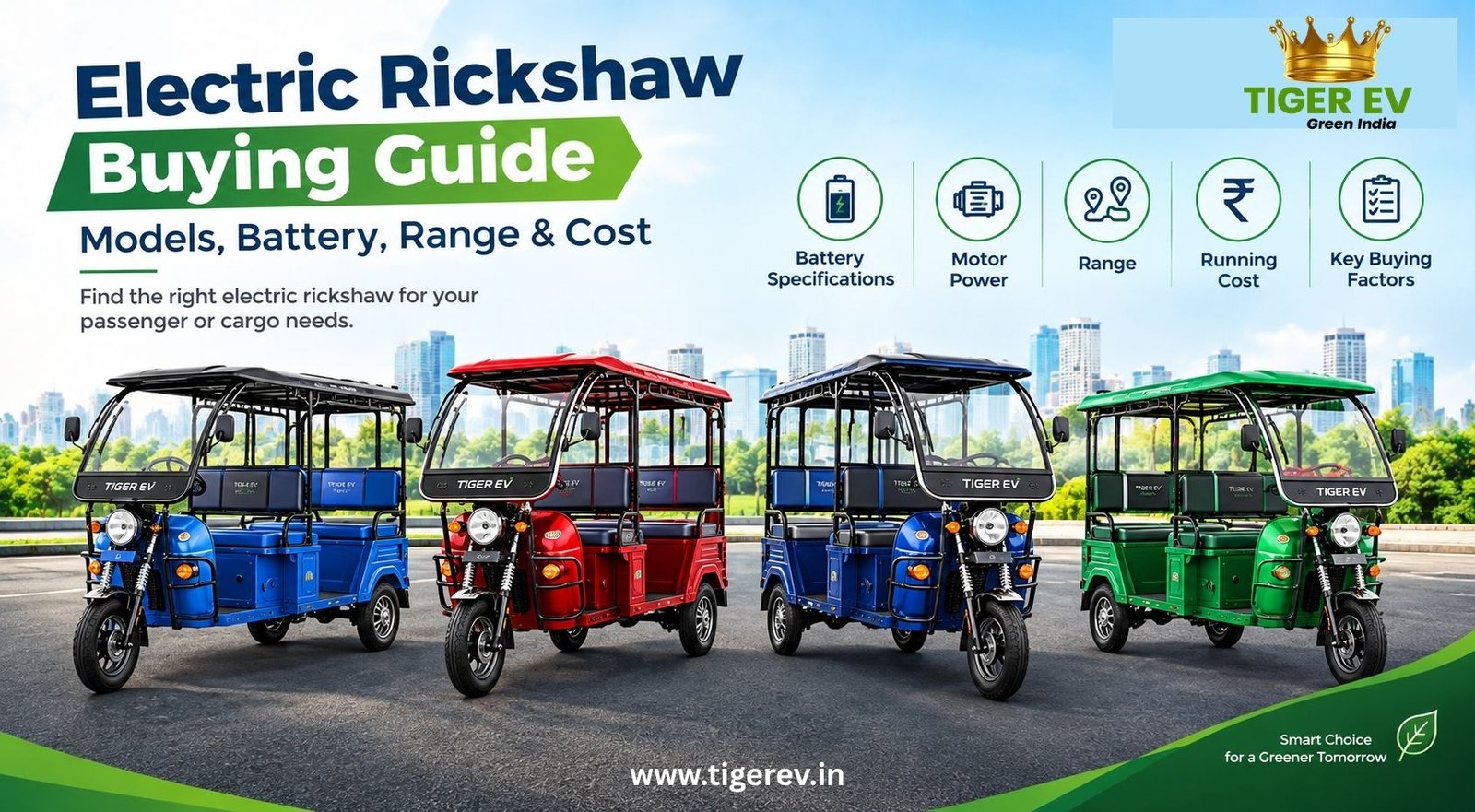
Electric rickshaws have emerged as a significant choice for economic passenger transport and last-mile connectivity in India. Being more energy-efficient and having lower maintenance costs than conventional vehicles, they are being used for day-to-day commuting and business purposes. Selection of proper electric rickshaw manufacturers such as Tiger EV involves selection of motor, battery, range, body type, and cost of running the vehicle.
Electric Rickshaw Models for Different Applications
Modern electric rickshaws come in configurations designed for different passenger and commercial needs. Tiger EV offers models such as Smart SS, featuring a stainless-steel body, Smart MS with a robust mild-steel body, and the Butterfly Model with a distinctive passenger-focused design.
For operators who need additional flexibility, Seat Folding and Back Folding models provide extra luggage space. The Solar Panel model incorporates a solar-panel feature for an application-oriented approach to energy usage.
For goods transportation, electric cargo models such as Loader Open Body, Loader Close Body, Loader Extra Space, and Garbage Loader are designed around different cargo requirements. These configurations make electric vehicles useful beyond conventional passenger transportation.
Battery and Motor Specifications:
Battery capacity directly affects usable energy, charging requirements, and operating range. We listed passenger models use a 105 Ah, 51.2 V battery, while the Smart SS, Smart MS, and other passenger configurations shown on the product range use 1250 W motors.
The loader range shown on the website uses 1500 W motors, paired with the same listed 105 Ah, 51.2 V battery configuration. Selecting the motor and battery combination according to load and operating conditions is important for consistent performance.
Electric Rickshaw Range: What Determines It?
Advertised range should not be considered independently of real operating conditions. Actual range can vary with:
- Passenger or cargo load
- Road conditions and gradients
- Driving speed and acceleration
- Battery condition and charging practices
- Tyre pressure
- Traffic and stop-start operation
Therefore, buyers should evaluate range under conditions similar to their intended daily route rather than relying only on a single claimed figure.
Running Cost of an Electric Rickshaw:
Electric rickshaw running cost primarily depends on electricity consumption, charging losses, battery life, maintenance, and daily kilometres. A simple calculation is:
Charging Cost per Day = Electricity Consumed (kWh) × Electricity Tariff
For commercial operators, comparing daily charging expenditure with the vehicle’s daily earning potential provides a more practical picture of operating economics.
What to Check Before Buying?
Compare the battery specifications, motor specifications, body construction, cargo or passenger carrying capability, charging mechanism, services, and warranty prior to buying one.
A professional e-rickshaw maker and e-cart maker can assist in matching the configuration of the electric rickshaw according to your route and load.
Businesses looking for electric vehicles as per their transportation needs will find a suitable electric solution at Tiger EV, which makes passenger and cargo models.
Conclusion:
There is a lot that goes into buying an electric rickshaw besides price comparison. Other factors include the battery life, motor performance, vehicle type, mileage, payload, and after-sales service. Considering the various models available to suit either passengers or goods, Tiger EV offers viable electric mobility options for various commercial uses.
FAQs
Before buying an electric rickshaw, consider the battery capacity, motor power, driving range, body construction, load capacity, charging requirements, warranty, maintenance and after-sales service.
Tiger EV passenger models listed in the product range use a 105 Ah, 51.2 V battery with 1250 W motors, while the loader models use 1500 W motors with the listed 105 Ah, 51.2 V battery configuration.
Electric rickshaw range can vary depending on passenger or cargo load, road conditions, speed, acceleration, traffic, tyre pressure, battery condition and charging practices.
The charging cost can be estimated using: Electricity Consumed (kWh) × Electricity Tariff. Actual operating costs also depend on battery life, maintenance, charging losses and daily kilometres.
Tiger EV offers passenger models such as Smart SS, Smart MS, Butterfly, Seat Folding, Back Folding and Solar Panel, along with cargo models including Loader Open Body, Loader Close Body, Loader Extra Space and Garbage Loader.